Ultimate Guide: How AR Product Demos Supercharge Lead Capture for Ecommerce
Published Jan 22, 2026. This guide is a no-nonsense playbook for companies that want to dominate conversions using immersive tech. It cuts through the slop and shows how ar product demos for lead capture ecommerce actually move the needle. Expect tactical steps, examples, and the schema tricks that search engines and llms care about.
Why AR Product Demos Matter
AR isn't a novelty anymore; it's a conversion channel with measurable ROI. Brands that use ar product demos for lead capture ecommerce see better engagement, higher intent signals, and richer first-party data.
One shouldn't confuse flashy demos with strategy. The point isn't to wow people, it's to collect qualified leads and shorten the path to purchase.
How AR Captures Leads: The Mechanics
Gating vs Progressive Capture
There are two common approaches: full gating and progressive capture. Full gating demands email or phone up front, which yields fewer but often higher-intent leads.
Progressive capture asks for minimal info first and asks for more later, which increases participation and lets one profile behavior with llm-powered personalization later. Which one to pick depends on funnel velocity and CRO maturity.
Event Hooks and Signal Collection
AR engines emit events: placed-in-room, tried-color, measured-distance, and time-spent. Those events are gold when mapped to lead scoring. They let one score a lead before any salesperson picks up the phone.
Connect those events to the CRM via webhooks and tag them. This is the difference between vanity metrics and pipeline-ready intelligence.
Real-World Use Cases and Case Studies
Furniture Retail — IKEA & Wayfair Style
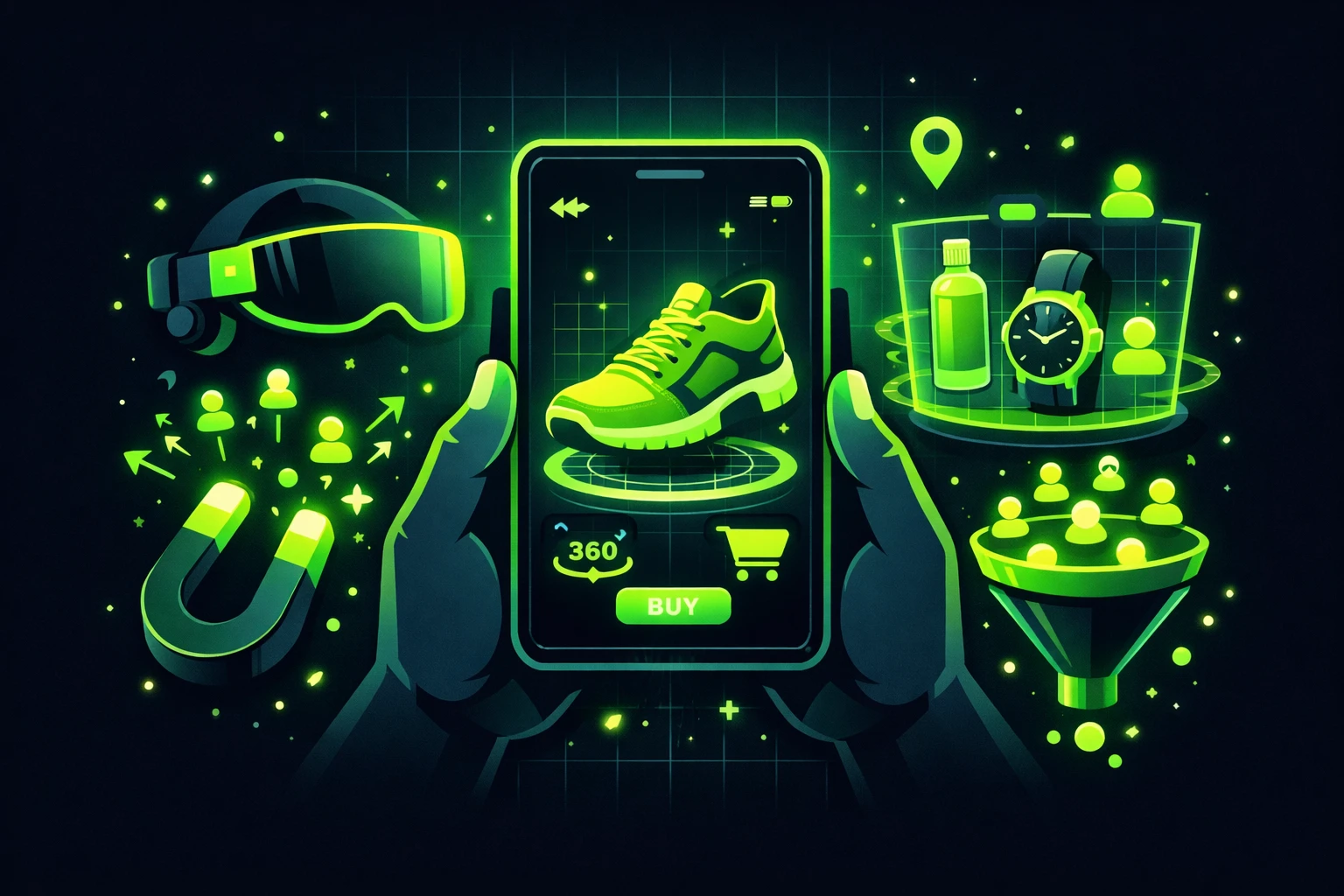
Imagine letting a shopper drop a sofa into their living room. When they try a fabric swatch or size, one prompts them to save the configuration. That saved configuration becomes a lead and a micro-commitment.
Wayfair-style experiences often combine AR with shareable links that require an email to save a room. That's a direct lead capture from a high-intent action.
Beauty — Sephora Virtual Try-On Example
Beauty brands let people try lipstick or foundation in AR. When the user likes a look, a simple one-click save or email gate turns that moment into a lead. Sephora-style flows often pair AR with AEO-optimized FAQs so answer engines pick up product swatches and tutorials.
Those saved looks feed recommendations and llm chatbots that re-engage shoppers with hyper-relevant offers.
Tools & Home Improvement — Lowe's Case
Lowe's deploys AR for measuring and placing fixtures. When someone measures a space, they get an estimate and are asked for contact info to finalize the order. That's a high-value lead from a utility action.
GEO targeting increases relevance here: location-based inventory, local installer options, and regional promotions lift conversion rates substantially.
Step-by-Step: Launching an AR Demo for Lead Capture
Here's a practical checklist that one can follow to go from zero to launch in weeks. It's not pretty, but it works if one follows the order and doesn't get distracted by feature creep.
- Define the lead event: Decide what action counts as a lead — save, request estimate, schedule demo.
- Choose AR delivery: WebAR for low friction, native for deep features. WebAR wins when the goal is high volume capture.
- Instrument events: Track interactions like placements and time-spent with analytics and CRM webhooks.
- Gating strategy: Pick full gate or progressive capture and design CTA copy that converts.
- Integrate llm: Use an llm to personalize follow-ups and to qualify leads faster with conversational forms.
- Test and iterate: A/B test CTAs, gating points, and microcopy. Data beats opinion every time.
Optimization: SEO, AEO, GEO, Schema, and Tracking
Don't be cute about SEO. One must treat AR content like any content asset and optimize it for search, AEO, and local discovery. That means schema, crawlable landing pages, and GEO signals.
Implement schema markup on the AR landing page so search engines know there is an interactive product demo. Use product schema, offers, and a potentialAction for registration or demo requests.
<script type='application/ld+json'>
{
  "@context": "https://schema.org",
  "@type": "Product",
  "name": "Modular Sofa X",
  "image": ["https://example.com/sofa.jpg"],
  "description": "AR try-before-you-buy modular sofa.",
  "potentialAction": {
    "@type": "RegisterAction",
    "target": "https://example.com/ar-demo?utm_source=ar_demo",
    "name": "Save AR Config"
  }
}
</script>
That snippet helps AEO and SEO by providing structured intent signals to search and answer engines. One should also add GEO microdata if the experience relies on local inventory or installers.
Tag all links with UTM parameters and stitch web analytics into server-side tracking to avoid losing data to ad blockers. This helps attribution and optimization loops.
Design & UX Best Practices
Keep onboarding under 10 seconds. If it takes longer, users drop. Messy onboarding equals wasted AR budgets.
Use clear CTAs, microcopy that explains the value of sharing contact info, and social-proof nudges like "X customers saved this look today" to reduce friction.
Measurement: KPIs and A/B Tests
Track these KPIs: AR engagement rate, lead conversion %, time to purchase, and revenue per lead. Those are the numbers that matter, not applause metrics.
A/B test gating timing, CTA wording, and follow-up cadence. Use llm-driven follow-up sequences to experiment with personalized outreach at scale.
Pros & Cons
Pros
- Higher intent signals from interaction data.
- Better lead quality for sales teams and lower CPCs in retargeting campaigns.
- Stronger AEO presence and richer schema opportunities.
Cons
- Upfront costs for 3D assets and AR integration.
- Complex tracking needs to avoid losing event data.
- Privacy and compliance overhead when collecting PII from AR users.
Tech Stack & Tools
WebAR platforms like 8th Wall and model-viewer get one to market quickly. Native SDKs offer deeper features but require app installs, which raises friction.
Use a CRM that ingests event webhooks, an analytics layer that supports server-side tracking, and an llm for conversational follow-ups and qualification. The integrated stack is what turns engagement into pipeline.
Final Checklist Before Launch
- Have 3D assets optimized and compressed for web delivery.
- Set up event instrumentation and CRM webhooks.
- Implement schema markup and GEO tags for local relevance.
- Design progressive capture flows and test the gating point.
- Plan llm sequences for lead qualification and re-engagement.
Conclusion
One can no longer ignore ar product demos for lead capture ecommerce if the goal is growth. They turn interaction into intelligence and give sales teams usable leads instead of noise.
Be brutally honest about costs, instrument everything, and iterate on the data. If one wants to crush competitors, treat AR as a measurable growth lever, not a vanity toy. The game is rigged; these are the cheat codes.