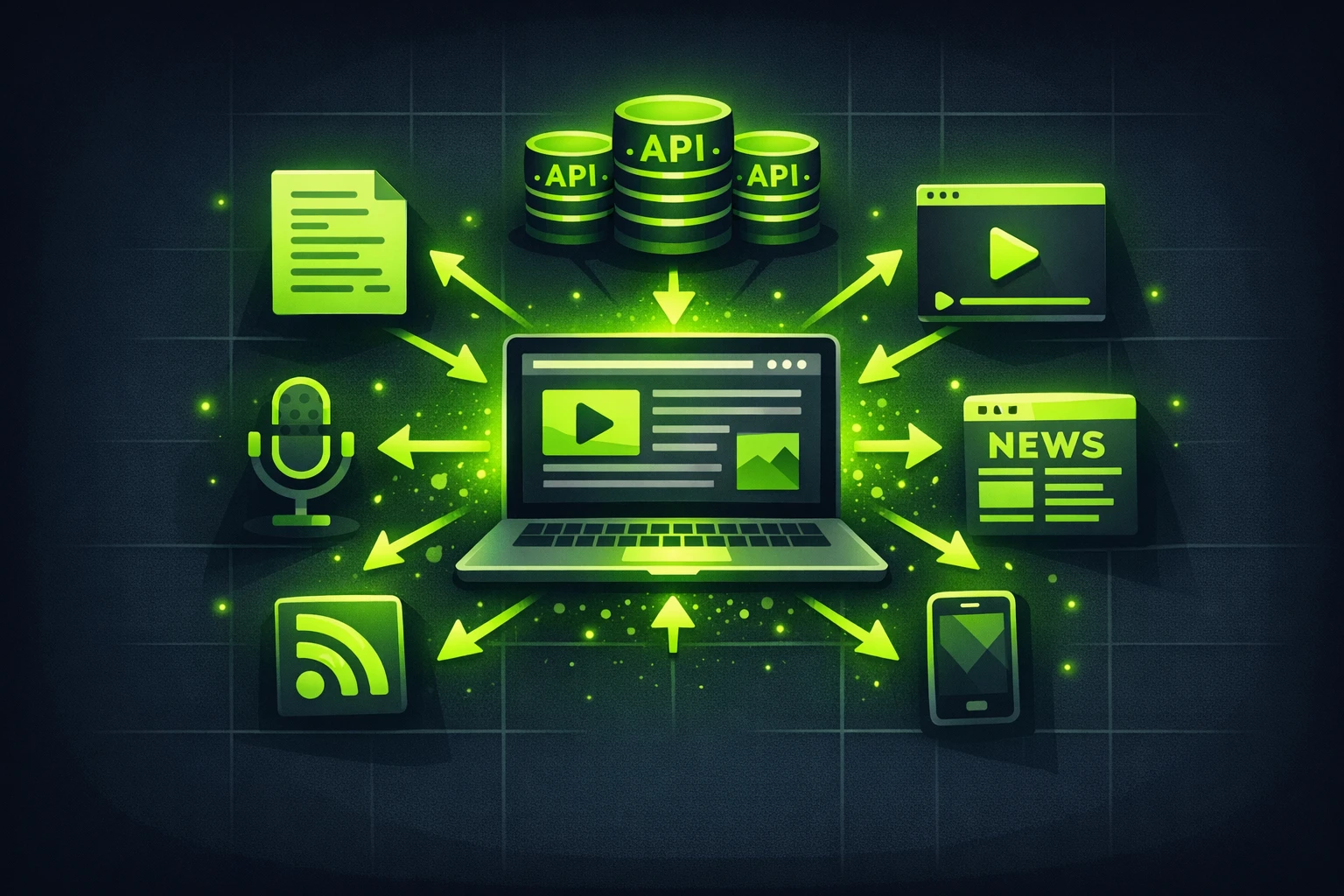
The Ultimate Content Syndication Playbook: How to Distribute Content via Public APIs (Step‑by‑Step Guide)
Published: January 25, 2026
Introduction — Why this playbook matters
One doesn't need a sugar-coated pitch to see why syndicating content via public APIs distribution playbook is crucial today. Traffic is a currency and results beat feelings every time, so this guide focuses on practical, actionable steps.
He or she reading this probably already knows AI content is often slop, yet still wants systems that scale without killing brand integrity. This playbook shows how to distribute content cleanly, safely, and with measurable ROI.
What is content syndication via public APIs?
At its core, syndicating content via public APIs distribution playbook is the plan to push content into third-party platforms using APIs. Instead of emailing publishers or manually posting, one automates sharing through documented endpoints.
They use schema markup, endpoint contracts, and auth flows so recipients ingest structured data consistently. This isn't magic — it's disciplined optimization for reach and control.
Why public APIs? Pros and cons
Pros
- Scalability: APIs let one push thousands of items programmatically without human bottlenecks.
- Control: One can enforce schema and metadata, so downstream platforms get clean inputs.
- Measurable: Track delivery, ingestion, and performance via logs and analytics.
Cons
- Complexity: Auth, rate limits, and versioning create engineering overhead.
- Risk: One can accidentally syndicate outdated or low-quality content widely.
- Dependency: Relying on third-party APIs risks sudden policy changes or rate restrictions.
How this ties to SEO, GEO, and AEO
Public API syndication must account for SEO and related signals. If one syndicates poorly, search visibility suffers or duplicates proliferate.
GEO targeting matters too when a platform serves regional audiences. AEO (Answer Engine Optimization) affects how content appears in knowledge panels and direct answers.
Step‑by‑Step Playbook
1. Plan the distribution strategy
Start with clear goals: is one chasing traffic, authority, or conversions? Goals determine the API partners and the schema one will use.
Map audiences, GEO priorities, and how each endpoint will consume metadata for AEO-friendly results.
2. Audit content and prepare canonicalization
He or she must avoid duplicate content traps by setting canonical URLs and canonical metadata before syndication. One should decide whether content on the partner site will use rel=canonical, redirects, or snippets only.
For publishers, canonical planning is non-negotiable. It keeps SEO juice and prevents getting sandwiched by cheaper replicas.
3. Choose API partners and map schema
Pick endpoints based on traffic quality, topical fit, and developer stability. Public APIs vary wildly in reliability and requirements.
Then design or adopt schema markup that matches each partner's contract. Schema choices matter for AEO and structured data parsing.
4. Implement authentication and rate-limit handling
Most public APIs require API keys, OAuth, or signed JWTs. One should automate token refresh and handle 429 responses gracefully.
Implement exponential backoff and queueing to avoid getting blacklisted. This part is engineering work, not marketing fairy dust.
5. Build the payloads and validation layer
Construct JSON payloads aligned to each API's schema. Include rich fields: titles, summaries, images, structured metadata, and schema markup snippets.
Validate payloads against OpenAPI or JSON Schema locally before sending. Errors at scale are costly and visible.
6. Cache, CDN, and latency strategies
Use a CDN to host canonical assets and optimize delivery of images and media referenced in API payloads. One shouldn't rely on slow origin servers when syndicating widely.
Leverage conditional requests and caching headers so partners can reduce load and improve ingestion times.
7. Monitoring, analytics, and LLM enrichment
Track delivery success, ingestion confirmations, and downstream traffic. Correlate these metrics with SEO and AEO outcomes.
If one uses an llm to enrich summaries or metadata, monitor hallucinations and set conservative thresholds. LLM output is powerful but can introduce slop if unchecked.
8. Legal, compliance, and content licensing
Contracts must specify rights, removals, and takedowns. One should avoid agreements that let partners republish content without attribution.
Ensure GDPR, CCPA, and other GEO-specific privacy rules are honored in APIs and analytics.
Real-World Examples and Case Studies
Example 1 — News publisher syndicating headlines
A national news publisher used a public news API to push headlines and first paragraphs to partner apps. They included canonical tags and schema markup for each item.
Within three months, referral traffic increased 28% while organic rankings remained stable. The key was strict canonicalization and rate-limited pushes.
Example 2 — Recipe site distributing structured recipes
A recipe brand syndicated content to smart kitchen devices using an API that required RichRecipe schema fields. They added AEO-focused snippets for voice assistants.
Result: voice-search impressions doubled and featured snippets appeared more frequently. The lesson was that schema and AEO thinking delivered measurable lift.
Example 3 — B2B SaaS distributing product content
A B2B SaaS firm published product docs through partner portals using OAuth-based APIs. They included versioning metadata and changelogs to prevent stale displays.
That discipline reduced support tickets by 34% and kept SEO intact, proving that engineering attention yields business results.
Technical checklist (copy-paste friendly)
- Define goals: traffic, conversions, authority.
- Map partners and GEO priorities.
- Design schema and validate JSON payloads.
- Implement auth, rate-limit, and retry logic.
- Set canonical rules and rel=canonical policies.
- Use CDN for media and caching headers for performance.
- Monitor delivery, AEO/SEO signals, and LLM outputs.
- Finalize contracts, takedown, and privacy clauses.
Comparisons: Manual syndication vs API automation
Manual syndication gives control but it doesn't scale. Copy-paste posting may avoid technical risk but wastes time and invites human error.
API automation scales and provides observability, yet it requires engineering discipline and governance. One chooses between short-term ease and long-term domination.
Common pitfalls and how to avoid them
- Ignoring canonical tags — Always set clear canonicalization to protect SEO.
- Over-relying on LLMs — Use llm enrichment judiciously and human-review critical fields.
- Skipping contracts — Never assume a partner won't republish aggressively without permission.
- Not monitoring rate limits — Implement backoff to avoid account suspension.
Quick templates
One can use this simple JSON snippet as a starting payload when testing integrations. Replace placeholders and validate against partner schemas.
{
  "title": "{{TITLE}}",
  "url": "{{CANONICAL_URL}}",
  "summary": "{{SUMMARY}}",
  "published_at": "{{ISO_DATE}}",
  "schema": {
    "@context": "https://schema.org",
    "@type": "Article"
  }
}
Final thoughts — Cut the fluff, get the lift
This guide isn't about vanity metrics or preaching 'quality' without scale. One's objective is to crush competitors and dominate distribution with measurable wins.
Syndicating content via public APIs distribution playbook is a pragmatic lever. Set your goals, build the schema, automate carefully, and let results speak.
Remember: the game is rigged, but the cheat codes are real. Use them wisely or get buried.