15 Must-Have Items on Your Enterprise RFP Checklist for AI Content Generation
Introduction
One can't pretend the AI vendor landscape is tidy; it's messy and fast-moving. This enterprise RFP checklist for AI content generation helps procurement, legal, and marketing teams cut through the slop and focus on measurable outcomes.
The list balances technical demands like llm performance, schema markup support, and security with business realities like pricing models and rollout planning. They'll get pragmatic criteria, examples, and steps to score vendors objectively.
The 15 Must-Have Items
1. Clear Scope and Use Cases
One must define precise content types, volumes, channels, and languages. Vendors should see sample prompts, desired voice, and expected output cadence.
Example: a global retailer might require product descriptions in 12 languages, SEO-optimized snippets for 100k SKUs, and GEO-aware landing pages. That clarity enables meaningful llm benchmarks.
2. LLM Performance & Evaluation Metrics
The RFP should demand benchmarks for relevance, factuality, hallucination rates, latency, and cost-per-token or per-output. Vendors need to submit test runs on representative prompts.
Step-by-step: provide a 20-prompt test set, request raw outputs, and score against human-reviewed gold standards for AEO and SEO goals. That creates apples-to-apples comparisons.
3. Data Privacy & Security Requirements
Security isn't negotiable; one must require encryption in transit and at rest, SOC2/ISO attestations, and clear data handling policies. Ask how training data is stored, shared, or retained.
Real-world: insist on tenant isolation or private deployment options for sensitive content. List pros/cons: multi-tenant saves cost but increases risk; private deployment costs more but reduces exposure.
4. Intellectual Property & Ownership
The RFP must specify who owns generated content and derivative works. Vendors often claim broad usage rights; don’t let vague terms creep in.
Example clause: all outputs created under contract are the customer's IP, and vendor may use anonymized aggregated telemetry only with prior consent. That prevents future disputes when content drives revenue.
5. Governance, Compliance & Ethical Controls
One should require policies for bias mitigation, audits, and human-in-the-loop review. Ask for harm assessments, red-team results, and a process to remediate model issues.
Vendor must describe monitoring cadence, escalation paths, and how schema or schema markup decisions will be audited for SEO or legal compliance. That's governance meeting operations.
6. Fine-Tuning, Customization & Training Data
Request details on fine-tuning workflows, data requirements, and retraining cadence. Vendors should clarify what data stays on-premises and what leaves the environment.
Case study: a publisher fine-tuned a model on proprietary style guides to cut editing time by 40%. Ask for sample tuning timelines and costs so procurement can forecast ROI.
7. Integration & API Specifications
Make vendors include API docs, SDKs, webhook capabilities, rate limits, and error handling behaviors. Integration complexity drives total cost of ownership.
Include a mini technical test: request an API call that returns a schema-validated HTML snippet with embedded schema markup. That verifies both content quality and developer ergonomics.
8. Observability, Logging & Audit Trails
One must require detailed logging of prompts, model versions, outputs, and usage metrics. These records support AEO testing and forensic audits after incidents.
Example logs: prompt ID, timestamp, llm version, confidence score, token counts, and downstream SEO/GEO flags. Ask for log retention windows and export options.
9. Performance SLAs & Uptime Guarantees
Define latency targets, throughput expectations, and acceptable outage windows. Vendors should state remedies and credits for SLA violations.
Comparison tip: measure average response time under production-like load. Don’t be swayed by theoretical peak throughput numbers without evidence.
10. Cost Model & Pricing Transparency
Demand detailed pricing: base fees, per-token or per-generation costs, enterprise seat fees, and overage rates. Hidden surcharges will wreck budgets.
Step-by-step: provide a 12-month usage forecast and ask vendors to model costs. Compare effective price per published asset across vendors to predict profitability.
11. Localization, GEO & SEO Considerations
The RFP should require GEO-aware content routing, local compliance support, and SEO output optimization. GEO rules often shape content flows and data residency needs.
Concrete ask: can the solution generate localized keywords and structured data such as schema markup per region? That directly impacts search ranking and conversions.
12. Content Quality Assurance & Human Review
Specify acceptance criteria, human review thresholds, and QA tooling. One must balance automation with editorial oversight to avoid brand risk.
Practical workflow: auto-generate drafts, flag outputs below a confidence threshold, and route to editors. That saves time while keeping legal and brand checks intact.
13. Explainability & Model Transparency
Vendors should provide model cards, training dataset descriptions, and explainability tools. Decision traceability helps when audits or AEO requests arise.
Example requirement: for any factual assertion, the vendor must return provenance metadata or a source-confidence score. That reduces hallucinations and legal exposure.
14. Roadmap, Support & SLAs for Updates
Ask for the vendor’s product roadmap, model upgrade policy, and migration plans. One wants predictable change windows and transparent deprecation timelines.
Support: require a named account team, escalation SLAs, and a training package for in-house staff. Vendors who hide their roadmap are avoiding accountability.
15. Exit, Data Portability & Decommissioning
One must mandate data export formats, schema mappings, and decommissioning timelines. Avoid vendor lock-in that steals future flexibility.
Checklist items: deliver raw logs, trained artifacts where permissible, and a migration plan. That ensures the enterprise can switch vendors without losing SEO value or schema-linked metadata.
Scoring, Weighting & Decision Framework
Don’t treat all items equally; assign weights based on business impact. For instance, security might be 25%, llm accuracy 20%, integration 15%, and cost 15%.
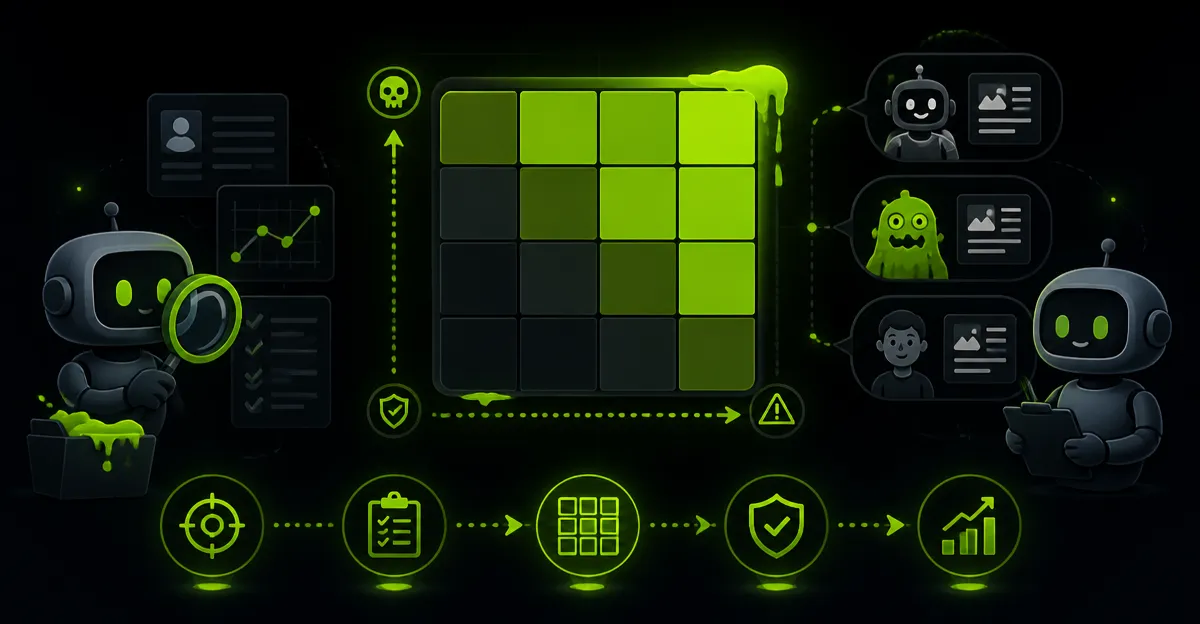
Provide a simple scoring matrix and an example evaluation run. That drives objective decisions and avoids debates about vendor charisma versus capability.
Conclusion
This enterprise RFP checklist for AI content generation is a practical blueprint to separate vendors who talk from vendors who deliver. One wants measurable SLAs, transparent pricing, and controls for governance and SEO/GEO/AEO impact.
They should use the checklist as a living document and iterate with real test prompts and schema examples. Results beat rhetoric — so test hard, score objectively, and choose the partner who helps the business win.