Programmatic SEO vs Traditional Marketing: The Ultimate Comparison for Slashing Customer Acquisition Costs (CAC)
Date: December 5, 2025
This comparison evaluates how organizations can reduce customer acquisition cost with programmatic seo versus classic traditional marketing channels, with practical steps and case studies.
Introduction
On December 5, 2025, many marketing teams are reassessing how they allocate budgets to lower customer acquisition costs. The choice between programmatic SEO and traditional marketing influences scale, predictability, and long-term spend efficiency.
This article compares both approaches across strategy, execution, costs, and measurable outcomes. It offers step-by-step implementation guidance, real-world examples, and recommendations to reduce customer acquisition cost with programmatic seo.
What Is Programmatic SEO?
Definition and Core Principles
Programmatic SEO is a data-driven method to create and optimize large sets of pages using automation and templates. It targets long-tail queries at scale by combining structured data, automated content generation, and technical SEO best practices.
One should view programmatic SEO as a systems design problem where content templates, templates logic, and indexing strategy combine to serve many relevant queries with minimal manual effort.
Key Components and Tools
Typical components include keyword clustering, content templating, dynamic page generation, canonicalization strategy, and indexing controls. Common tools include Google Search Console, BigQuery, Python scripts, headless CMS, and automated testing suites.
Examples of platforms used for programmatic SEO include Next.js for dynamic rendering, headless WordPress or Contentful for templating, and crawler tools such as Screaming Frog for quality checks.
What Is Traditional Marketing?
Definition and Typical Tactics
Traditional marketing refers to paid advertising, broadcast, direct mail, and direct-response campaigns that depend on human-led creative development. It often includes media buys in search ads, display ads, social ads, and offline channels.
Teams plan campaigns with defined creative assets, bidding strategies, and audience targeting methods. Campaigns often require iterative A/B testing and frequent media spend adjustments to converge on acceptable CAC levels.
Typical Spend Models and Expectations
Traditional digital marketing typically follows pay-per-click or impression-based pricing models, which create continuous cost pressure. Performance can be rapid but requires continuous media spend to maintain volume.
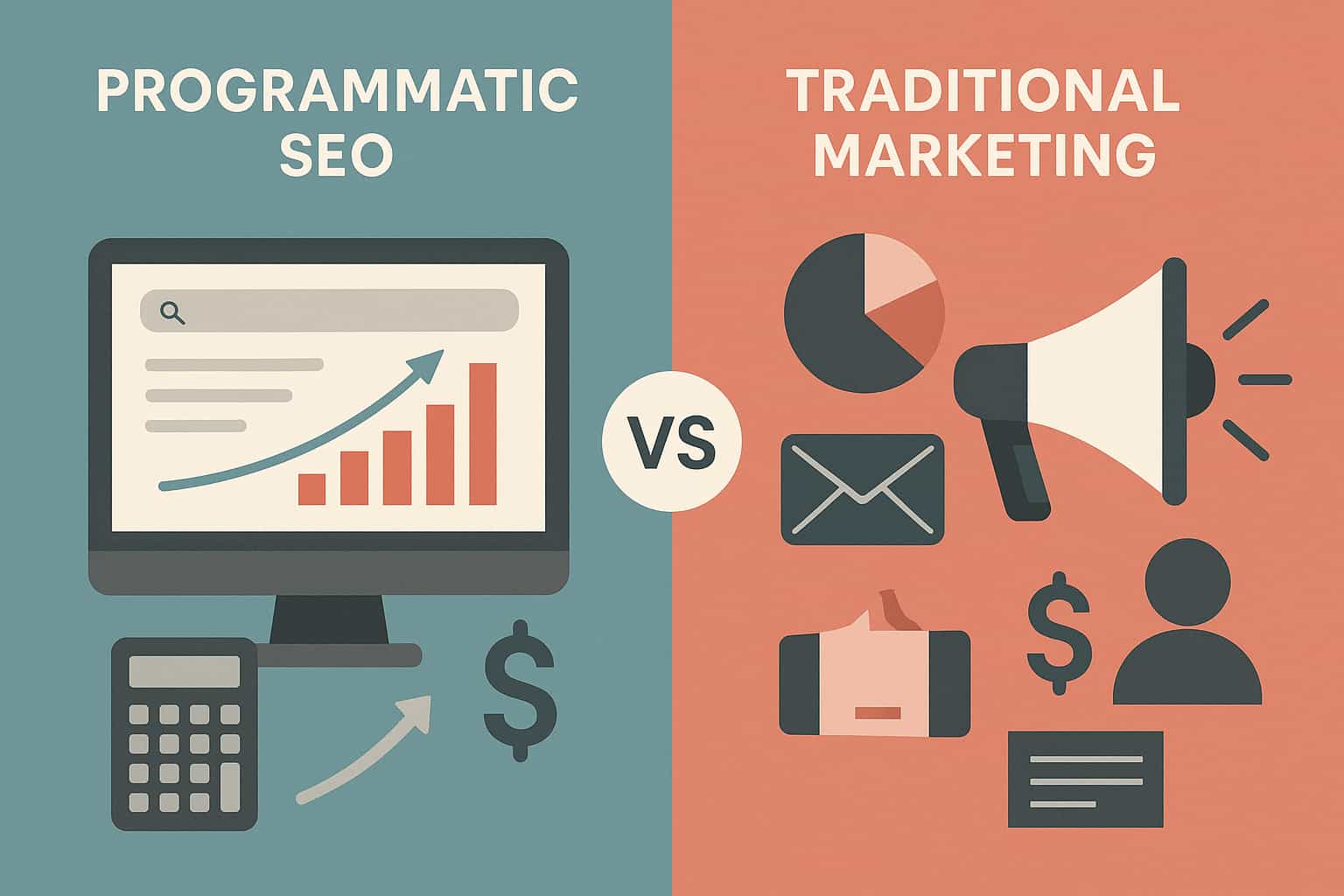
By contrast, programmatic SEO requires upfront engineering and content investment but can produce compounding organic traffic that decouples volume from media spend over time.
Direct Comparison: Reach, Scalability, and Cost
Reach and Audience Intent
Traditional marketing excels at demand stimulation and immediate reach across audiences with high-level targeting options. It captures users across awareness stages but often pays a premium for low-intent reach.
Programmatic SEO targets search intent and long-tail queries, capturing users with higher purchase intent or specific informational needs. Over time, programmatic SEO builds organic authority that sustains acquisition without per-click charges.
Scalability and Operational Overhead
Traditional campaigns scale by increasing media budgets, which increases cost linearly. Content production and creative complexity also scale with campaign variations, increasing overhead.
Programmatic SEO scales by extending templates, datasets, and automation logic. The marginal cost of serving additional search queries declines after initial engineering investment, enabling long-term CAC reductions.
How Each Approach Impacts CAC
Traditional Marketing: Immediate CAC Control
Traditional channels give tight short-term control over customer acquisition volume through bidding and budget caps. CAC visibility is immediate through ad platforms and attribution models.
However, sustained lower CAC requires continuous optimization, creative refreshes, and media spend; thus, CAC often becomes a variable recurring expense rather than a depreciating asset.
Programmatic SEO: Long-Term CAC Reduction
Programmatic SEO typically involves higher upfront engineering and content costs but converts that work into an owned organic channel. Over months, acquisition costs per customer often fall as content accumulates and ranks for many queries.
For organizations seeking to reduce customer acquisition cost with programmatic seo, the model offers predictable diminishing marginal cost per acquisition as indexed pages attract traffic without direct media spend.
Step-by-Step Implementation: Programmatic SEO to Reduce CAC
Step 1 — Audit and Keyword Clustering
Begin with a full SERP audit and keyword discovery to identify high-opportunity clusters and templatable intents. Use tools such as Ahrefs, Semrush, and Google Search Console to extract long-tail queries and volume estimates.
Create a keyword matrix that maps attributes to template variables and ranks opportunities by conversion potential and competition intensity.
Step 2 — Template Design and Data Modeling
Design content templates that handle variations in intent, entity attributes, and schema markup. Define canonical rules and pagination logic to prevent duplicate content and index bloat.
Model datasets that feed templates, including product attributes, geo-targeting fields, and local business metadata. Use JSON-LD for structured data and ensure consistent schema across templates.
Step 3 — Automated Page Generation and QA
Automate page creation with scripts or headless CMS flows. Integrate QA checks to validate meta tags, content uniqueness, load performance, and schema integrity before indexing requests.
Use crawl simulation and staging environments to observe how search engines might render generated pages and to optimize internal linking strategies for discoverability.
Step 4 — Indexing and Monitoring
Submit high-priority pages to the index via sitemaps and indexing APIs, then monitor performance with Google Search Console and server logs. Track click-through rates, impressions, and conversion rates per template.
Iterate on templates by A/B testing headlines, meta descriptions, and internal linking to steadily improve organic conversion and aggregate CAC reductions.
Case Studies and Real-World Examples
Example 1 — Marketplace Reducing CAC by 40%
A large online marketplace implemented programmatic SEO across 120,000 category-location combinations. The organization automated content templates and structured data, focusing on transactional long-tail queries.
Within nine months, organic traffic for target templates grew 250 percent and CAC from organic channels decreased by approximately 40 percent compared to equivalent paid campaigns.
Example 2 — SaaS Firm Combining Channels
A SaaS company combined programmatic content hubs with targeted paid search for high-intent keywords. The firm used programmatic pages to capture early-stage intent and remarketed to those visitors with efficient paid offers.
The hybrid model lowered overall CAC by 22 percent while maintaining lead volume and improving lifetime value through better-qualified leads.
Pros and Cons
Programmatic SEO
- Pros: Low marginal acquisition cost, scalable content footprint, durable organic traffic, improved long-term ROI.
- Cons: Upfront engineering cost, risk of index bloat, content quality management, longer time to initial ROI.
Traditional Marketing
- Pros: Immediate reach and control, fast testing cycles, reliable short-term lead volume.
- Cons: Linear cost scaling, ongoing media spend, diminishing returns on fatigue and competition.
Metrics to Monitor
Key performance indicators include CAC, LTV:CAC ratio, organic impressions, organic clicks, conversion rate per template, and time-to-first-conversion. These metrics reveal how programmatic SEO affects both short-term and long-term acquisition economics.
Teams should track index coverage, crawl budget behavior, and rankings for top-priority clusters to ensure the program scales without quality regressions.
Recommendations and Best Practices
Organizations seeking to reduce customer acquisition cost with programmatic seo should invest in high-quality templates, rigorous QA, and a phased rollout aligned to product-market fit. Initial MVP templates should target high-conversion, low-competition queries.
It is prudent to combine programmatic SEO with selective paid campaigns during ramp-up to sustain pipeline while organic pages mature. Continuous measurement and iterative improvements sustain CAC reductions over multi-quarter horizons.
Conclusion
Programmatic SEO and traditional marketing serve distinct roles in an acquisition stack, and a hybrid approach often yields the best balance between speed and cost-efficiency. Businesses can reduce customer acquisition cost with programmatic seo by treating content as an engineering project that yields durable, compounding returns.
One should evaluate resources, time horizon, and product complexity when choosing a primary path. When implemented carefully, programmatic SEO becomes a strategic lever to lower CAC and increase long-term marketing ROI.